API Integrations
API integrations that end the re-typing.
We connect your website and your business systems, CRM, accounting, payments, calendars, so information entered once flows everywhere it belongs. Each integration is scoped and quoted fixed, in writing.
What this is
Software talking to software, so your staff don’t have to.
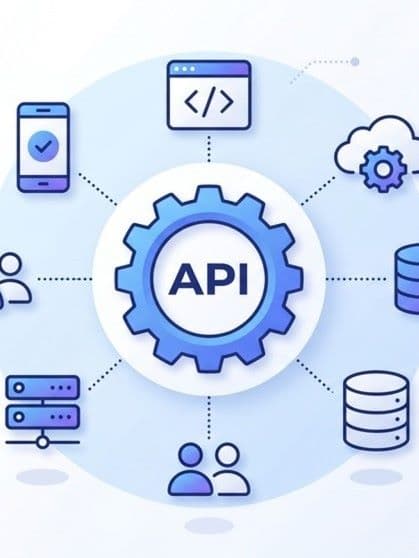
An API is the connector modern software exposes so other software can talk to it. An integration is us wiring two of your systems together through those connectors. The enquiry form feeds the CRM by itself. The order books itself into your accounting. The appointment lands on the right calendar and confirms itself to the customer.
Who it’s for: any business where a person spends part of their week copying information from one screen into another. That includes companies that bought a CRM nobody updates, stores reconciling orders by hand, and firms whose “reporting” is three exports merged in Excel every month.
The problem
Every handoff between systems is a delay and a risk.
Watch an enquiry travel through a typical business. It lands in an inbox. Someone copies it into the CRM, on Friday, if it’s quiet. Sales calls three days later and the lead has already hired someone who answered the same afternoon. Later the invoice gets re-typed into the accounting software, with one digit wrong.
None of these steps looks expensive on its own. Added up across a year, they’re an employee’s worth of hours spent moving data that could move itself.
What we connect
The usual suspects, and anything with an API.
If a tool has an API, and nearly everything does now, it can join the party.
CRMs
HubSpot, Zoho, Salesforce, and the rest. Enquiries, quotes, and deal updates flowing in without a human courier.
Accounting
QuickBooks, Xero, and similar. Orders and invoices arriving as entries, not as typing.
Payments
Stripe and regional gateways, reconciled against orders automatically.
Calendars and booking
Appointments landing where they should, with confirmations going out on their own.
Messaging
Order updates and lead follow-ups over WhatsApp and email, triggered by real events.
Inventory and ERP
Stock levels that agree with reality across your store and your warehouse system.
How we work
Direct where it pays, simple where it doesn’t.
The data flow gets mapped first
What enters where, what should happen next, and what “correct” looks like. You approve the map before anything is built.
The right size of solution
Some connections deserve custom code. Others are honestly a $20-a-month Zapier setup, and when that’s true, we’ll say so and charge you for an afternoon, not a project.
Built for the failure case
APIs go down, formats change, duplicates happen. Our integrations log what they do, retry what fails, and alert someone when a human is needed. That’s the difference between working in the demo and working in year two.
Credentials handled like they matter
Least-access permissions, keys stored properly, and nothing kept that we don’t need.
Why us
Why teams hand us their plumbing.
We build around what you have
No agenda to replace your CRM or move your accounting. The tools stay; the copying stops.
Fixed quote per integration
Mapped, priced, and dated in writing before work starts.
The same team builds your bigger things
Integrations often grow out of, or into, custom applications, and here that’s one conversation instead of two vendors blaming each other.
We stay on watch
A care plan keeps the integration monitored and maintained as the connected tools change underneath it. And they will.
Process
From map to monitored.
Map
A call to trace how data moves today and where it should move by itself.
Quote
One fixed price per connection, in writing.
Build and test
On staging first, against the ugly cases: duplicates, failures, missing fields.
Launch and monitor
Live, logged, and alerting. Care plan optional but recommended, because APIs change without asking.
“A great addition to our team. They communicated every step of the way and had the job done sooner than expected.”
Common questions
All servicesEach connection is quoted individually after mapping, because “website to CRM” can be an afternoon or a fortnight depending on the systems and rules involved. Whatever the answer, it’s one fixed price in writing before we start.
A doorway that software opens so other software can pass information through it. Your CRM, your accounting tool, and your website all have one. Integration work is building the corridor between the doorways.
Almost certainly. If the CRM has an API, and every serious one does, your enquiry forms, quotes, and customer updates can flow into it automatically. Name the CRM on the call and you’ll get a straight answer.
There are workarounds: scheduled imports, file drops, middleware. Sometimes the honest advice is that the tool without the API is the weak link, and we’ll tell you that too.
Both, deliberately. Zapier and similar tools are the right answer for simple, low-volume connections. Custom code is right when volume, logic, or reliability demands it. You’ll get the cheaper option whenever it genuinely does the job.
Ours log their work, retry failures, and raise an alert when something needs a human. Under a care plan, that alert comes to us and usually gets fixed before you’d have noticed. Connected tools change their APIs over time, so unmonitored integrations all break eventually.
Access is scoped to the minimum each connection needs, credentials are stored properly, and we don’t retain data the integration doesn’t require. You keep ownership and can revoke our access at any time.
Next step
Tell us what gets copied where.
Describe the re-typing on a free 30-minute call. We’ll tell you which connections would end it, what each costs, and which ones aren’t worth building. Yes, sometimes that’s the answer.

Felix Dalyop, Founder, Client Relations — he’s the one who answers.