Performance & Core Web Vitals
Core Web Vitals: from failing to passing, measurably.
We take sites that fail Google’s speed tests and make them pass, with the before and after recorded in Google’s own tools. WordPress, Shopify, Webflow, or custom. Diagnosis first, then one fixed quote.
What this is
Google’s three measurements of how your site feels.
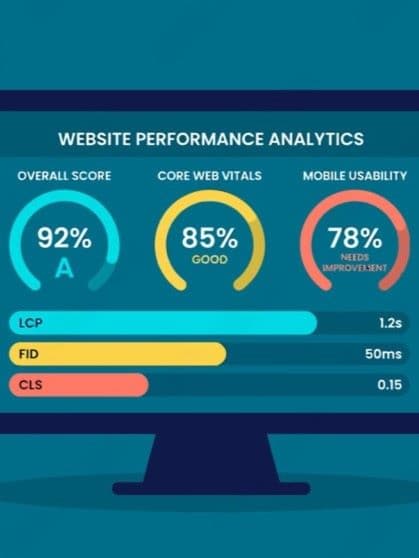
Core Web Vitals are collected from real visitors using Chrome, and they measure three things. LCP: how quickly the main content appears. INP: how quickly the page responds when someone taps. CLS: whether the layout jumps around while loading. Google reports the verdict in Search Console, page by page, pass or fail.
Who it’s for: businesses flagged as failing in Search Console, stores watching mobile sales underperform, companies whose ad costs keep climbing on slow landing pages, and anyone whose site simply feels heavy and doesn’t know why.
Why it matters
The ranking effect is real. The abandonment effect is bigger.
Here’s the calibrated truth most agencies won’t give you: Core Web Vitals influence rankings, but modestly. They’re closer to a tie-breaker than a magic lever, and anyone selling speed as a rankings rocket is overselling.
The larger cost is human. Your visitor is on a phone, on mobile data, between other things. Three seconds of white screen and they’re back on Google tapping the next result, which is a competitor. Slow sites don’t feel slow to their owners, who browse them on office wifi with a cached copy. They feel slow to the people deciding whether to call you.
The problem
Nobody decided to make the site slow. It accumulated.
A hero image uploaded straight from the camera at 4000 pixels wide. A marketing tag added for one campaign in 2023 and never removed, then four more. A theme that ships every feature you didn’t buy. A cookie banner that loads late and shoves the page down, which is that layout jump Google measures. Hosting chosen on price back when it didn’t matter.
Each choice was reasonable. The sum is a site that fails, and no single person in the business can see why.
How we fix it
Diagnose with real data, fix the big rocks, verify in the field.
Field data first
Google’s lab tools estimate; the field data from real visitors decides your verdict. We read both, and we’ll show you the difference, because chasing a lab score while real users still suffer is how speed projects waste money.
LCP: make the main thing arrive first
Right-sized images, priority loading for what matters, and a server that answers quickly.
INP: put the scripts on a diet
Third-party tags audited one by one. The ones that earn nothing get removed, not deferred and forgotten.
CLS: stop the jumping
Space reserved for images, embeds, and banners before they arrive, so the page you tap is the page that stays put.
Tested where your users are
Real phones, throttled connections. Office wifi lies.
Staying fast
Passing once is a result. Staying passed is a habit.
Regressions come from ordinary life: a new plugin, another marketing tag, a video someone embedded on the homepage. We set a performance budget for the site and, under a care plan, watch the field data so drift gets caught in weeks, not discovered next year. Prefer to self-manage? You get the guardrails in writing.
Why us
Speed is our default setting, not our upsell.
Every site built here targets a load time under two seconds and PageSpeed scores of 98 and up, because we write lean code from the start. Speed work for other people’s sites is the same discipline applied in reverse: find what’s heavy, remove it, prove the change.
You don’t have to take the claim on faith. The site you’re reading is our work; run it through PageSpeed Insights right now. That’s the standard your site gets held to.
Diagnosis comes before the quote, the fixes are code changes rather than settings-fiddling, and the results are measured honestly: before and after, from Google’s tools, including the wait for field data to catch up. No screenshots of hand-picked lab runs.
Process
From diagnosis to a flipped report.
Diagnose
Field and lab data read together, causes ranked by impact, explained in plain language.
Quote
One fixed price for the fixes worth making. If the honest answer is “change your hosting and skip the project,” that’s what you’ll hear.
Fix
We change the code, the images, the scripts, and the server setup as needed.
Verify
Google’s field data moves on a rolling 28-day window, so the Search Console verdict flips in the weeks after fixes land. We stay with it until it does.
Keep
Performance budget set, monitoring optional under a care plan.
Common questions
All servicesThe usual causes: oversized images, a pile-up of third-party scripts, layout shift from late-loading banners and embeds, or slow hosting. Every failing site has its own mix, which is why we diagnose before quoting. Guessing is how speed budgets get wasted.
LCP is how long the main content takes to appear. INP is how quickly the page reacts when someone taps or types. CLS is how much the layout jumps around while loading. Google grades each from real visitor data and your site passes or fails per page.
Yes, modestly. They matter most as a tie-breaker between comparable pages. The bigger effect is on people: slow pages get abandoned, and abandoned visits never become enquiries. Fix speed for the customers and take the ranking nudge as a bonus.
The fixes land quickly; the verdict follows. Google’s field data works on a rolling 28-day window, so expect the report to flip within about a month of the work going live. We track it with you until it does.
Usually, yes. Theme weight, plugin sprawl, unoptimised images, and missing caching account for most slow WordPress sites, and all are fixable in place. If the build is genuinely beyond saving, we’ll say so with reasons, not a reflex rebuild quote.
Yes. App diet, theme cleanup, and image discipline recover most of what Shopify stores lose. Some things sit inside Shopify’s own infrastructure and no agency can touch them; we’ll be clear about which side of that line your problems are on.
Diagnosis comes first, then one fixed quote scoped to what’s actually wrong. Small problems get small prices. What you won’t get is a generic “speed package” that treats every site the same.
If nothing changes, yes. In practice sites regress through new plugins, tags, and content, so we set a performance budget and offer monitoring under a care plan. Either way you’ll know exactly what not to do to keep the verdict green.
Next step
Find out why it’s slow before you pay anyone to fix it.
Send your URL through the contact form. On a free 30-minute call we’ll tell you the biggest thing slowing your site down and what fixing it involves. Diagnosis talk is free; you decide from there.

Felix Dalyop, Founder, Client Relations — he’s the one who answers.