Most Nigerian businesses choose a payment gateway by comparing percentages. It is the wrong first question. The right one is how your customers actually want to pay, because a cheaper gateway that handles the wrong method will cost you far more in abandoned checkouts than it saves in fees.
Bank transfer is not the backup option
In a lot of markets, card is the default and transfer is a fallback for people whose card failed. In Nigeria that relationship is closer to reversed.
Instant transfer through NIP is fast, familiar, and does not involve entering card details on a site the customer met five minutes ago. For a meaningful share of buyers it is the preferred route, not the fallback. Card declines are also common enough that a card only checkout quietly loses sales you never hear about.
So the first requirement is that transfer works properly, and properly means the payment reconciles automatically. If a customer transfers and then has to send a screenshot on WhatsApp so someone can match it manually, you have built a process that breaks the moment you get busy.
What the main options are actually good at
Paystack. The sensible default for most Nigerian businesses. The developer experience is the best of the group, the plugin ecosystem is the widest, and the checkout handles cards, transfer, USSD and virtual accounts in one integration. If you have no strong reason to choose otherwise, choose this.
Flutterwave. Stronger when you are collecting beyond Nigeria. If you sell into Ghana, Kenya or further, or take international cards regularly, the cross border coverage is the reason to pick it.
Monnify. Worth a serious look if transfer dominates your business. The dedicated virtual account per customer means each buyer gets their own account number, so transfers reconcile automatically without anyone matching references by hand. For businesses taking a high volume of transfers, that alone can justify the choice.
Interswitch, Squad, Remita. All established. Remita in particular shows up where government or large institutional payments are involved.
Fees, now that the order is right
Local card fees cluster around 1.5 percent with a cap, which matters a great deal for high value items. On a large order, a capped fee is dramatically cheaper than an uncapped percentage, and this is the single most important number to check.
International cards cost considerably more, typically in the 3.5 to 3.9 percent range, because the risk and the interchange are different. If you sell mostly to Nigerians abroad, model this properly rather than assuming the local rate.
Transfers are usually a small flat fee, which is why they are attractive on larger baskets.
Settlement timing is a cash flow decision
Ask when money actually reaches your bank account. Next day is common, same day is sometimes available, and for a business buying stock weekly the difference is not academic.
Also ask what happens to a failed or reversed transaction, and how long a dispute takes. These are boring questions until the week you need the answers.
The checkout details that lose sales
Even with the right gateway, checkouts leak in predictable places.
- Too many fields. Every optional field costs you completions. Name, phone, delivery address, done. You can ask the rest later.
- Phone number formats. Accept 0803, +234803 and 234803 without complaining. Normalise it on your side rather than making the customer guess.
- No order confirmation on the page. After payment, show the confirmation immediately rather than relying on an email that may take minutes. People need to know it worked before they close the tab.
- Delivery cost appearing late. If shipping is calculated at the final step, you will lose people who had already decided to buy.
Give people a way to ask first
A large share of Nigerian buyers want to speak to a human before paying, particularly for anything above a small amount. That is not a failure of your checkout, it is how trust gets established in a market with plenty of reason for caution.
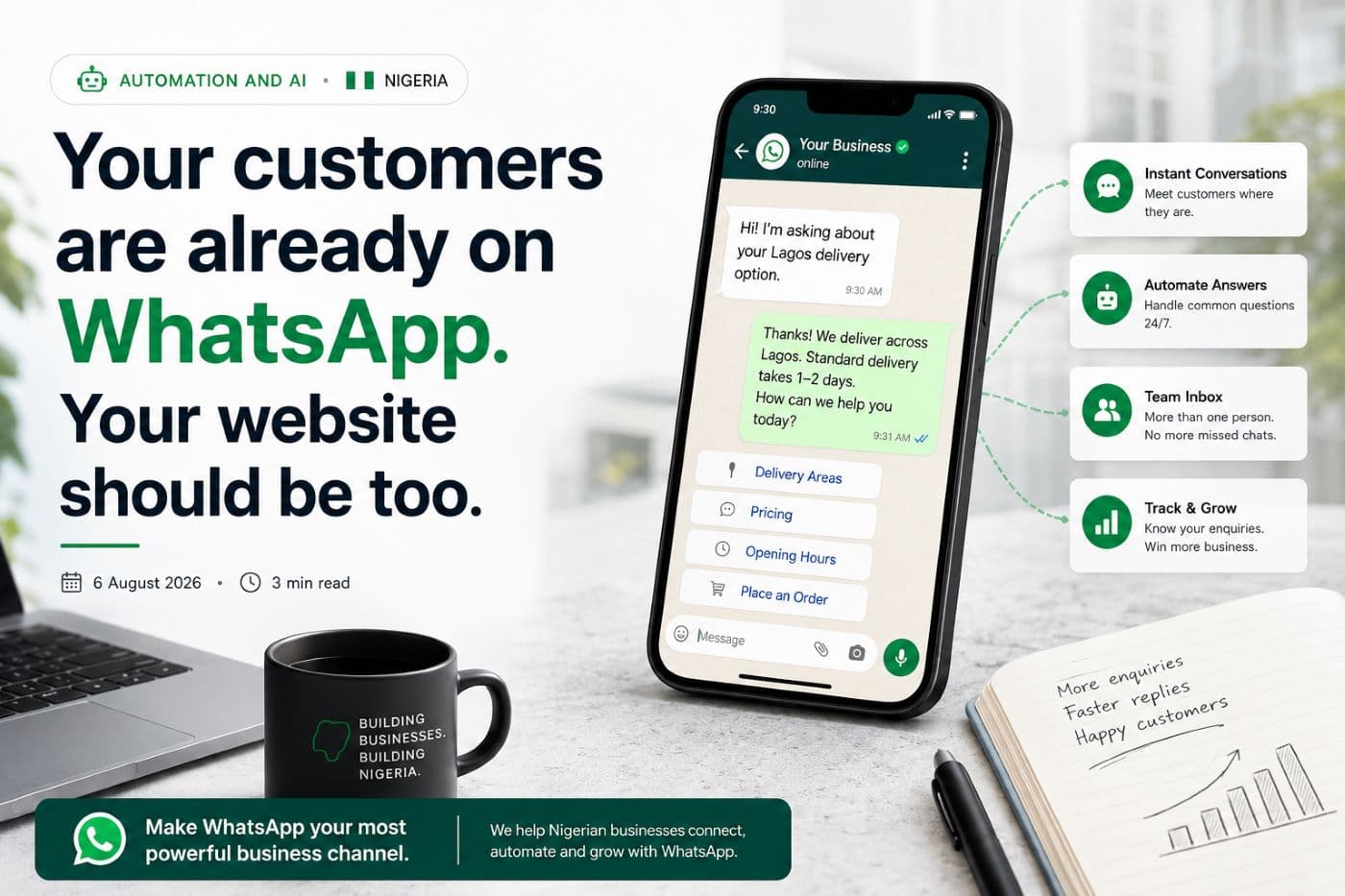
Put a WhatsApp route next to the buy button rather than treating it as competition for it. The conversation frequently ends in a completed order, and the ones that do not would not have converted anyway. We cover the mechanics in WhatsApp automation.
See how we work with Nigerian businesses, or tell us how your customers pay and we will suggest the fit.
Building something in Nigeria?
Nigeria — We design and build fast, lightweight websites and AI customer experiences for ambitious Nigerian businesses — WhatsApp-native, quick even on mobile data, and built to convert. Fixed quote, senior people on every project.
What we do in Nigeria