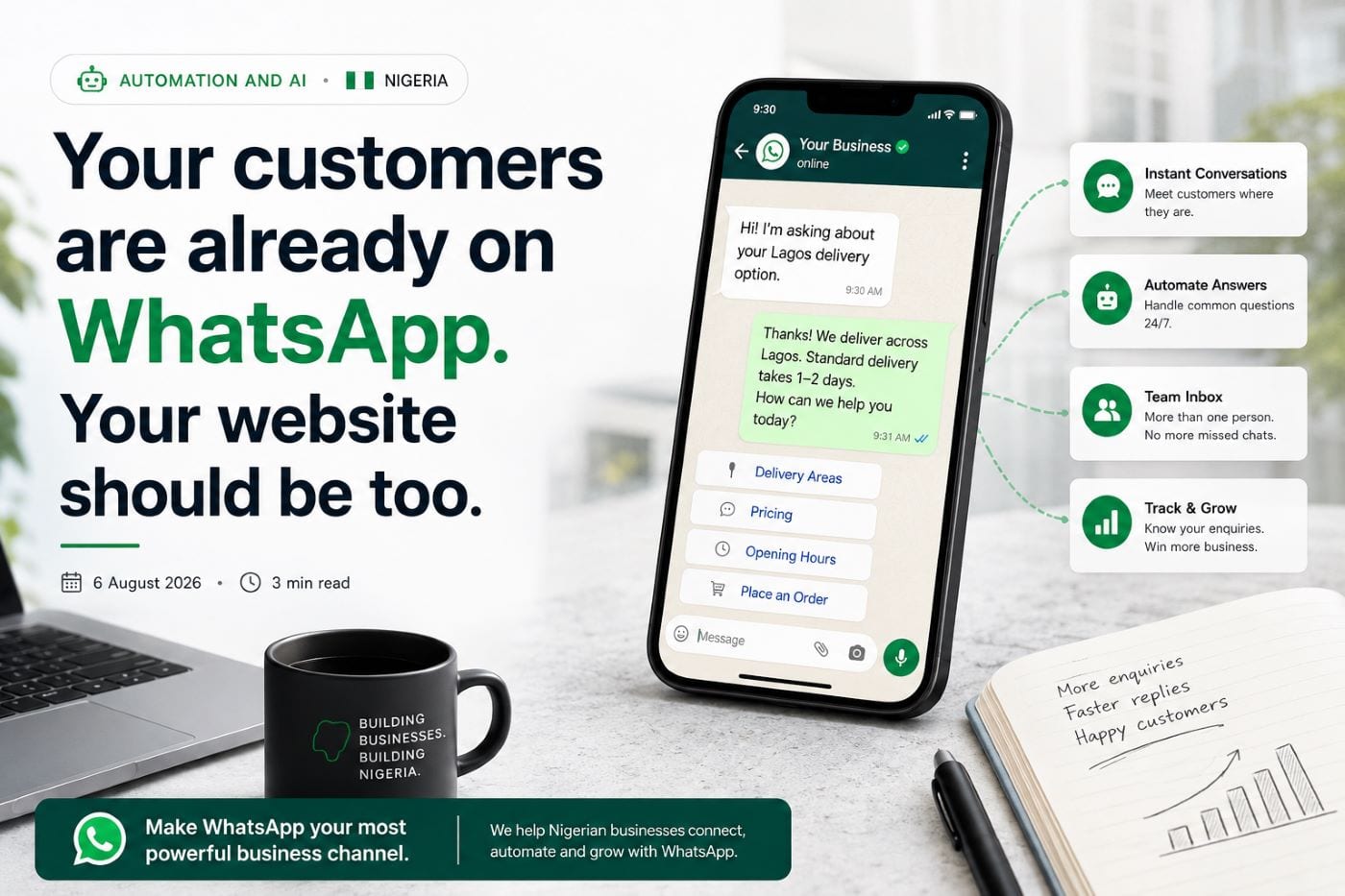
Every business we work with in Lagos has the same story. The website has a contact form. The form works. Almost nobody uses it. Meanwhile the owner's personal WhatsApp has four hundred unread messages, half of them genuine enquiries.
The website is not failing because it is bad. It is failing because it is asking people to communicate in a way they abandoned years ago.
Why contact forms lose enquiries
A contact form asks for a lot before giving anything back. Name, email, phone, a message composed in a small grey box, then a submit button and silence. The customer has no idea whether it arrived, whether anyone read it, or when they might hear back.
WhatsApp asks for none of that. They already have it open. They can see the message delivered. They can see you typing. The gap between wanting to ask and having asked is roughly two seconds.
Every extra step between an interested customer and a conversation is a place you lose some of them.
The version most sites get wrong
Adding a WhatsApp button is easy, and most businesses stop there. Which creates a second problem: every enquiry now lands in one person's personal phone, mixed in with family messages and group chats.
That works until it does not. Specifically it stops working when:
- That person is asleep, travelling, or on leave, and enquiries silently pile up.
- Two people need to answer, and there is no way to see what the other already said.
- Someone asks about an order from three weeks ago and the history is buried.
- You want to know how many enquiries you actually got last month, and nobody can tell you.
What connecting it properly looks like
The goal is that WhatsApp stays the customer's experience, while stopping it from being a black hole on your side.
Give the message context before it arrives
A WhatsApp link can carry a pre-filled message. Someone clicking from a product page can arrive with "Hi, I'm asking about the Lagos delivery option" already typed. You know what they are looking at before you say a word, and they skipped the explaining.
Answer the repetitive questions automatically
Most first messages are the same handful of questions: opening hours, location, price range, whether you deliver. Those can be answered instantly, at 2am, without anyone typing. It is not a chatbot pretending to be human. It is the FAQ, delivered where the question was actually asked.
The point is not to remove people. It is that a real person should be answering the interesting half, not typing the address for the ninetieth time.
Put enquiries somewhere you can see them
Once conversations flow into a shared inbox or your CRM instead of a personal phone, you get the things a business actually needs: more than one person able to reply, history that survives someone changing phones, and a count of how many enquiries came in and how many turned into work.
This is the part that turns WhatsApp from a channel into a system. We build it as WhatsApp automation, usually alongside the site itself.
Keep the form as well
Not everyone wants to message you. Some buyers, particularly corporate and government ones, will want a written trail with an email address attached. Keep the form. Just stop treating it as the primary route when it is not the one people use.
A reasonable first step
You do not need a whole automation platform to start. In order:
- Put a WhatsApp link where your phone number currently is, on every page.
- Pre-fill the message on your main product or service pages.
- Move it off a personal number to a business number more than one person can reach.
- Automate the four questions you answer every single day.
The first two take an afternoon and usually produce a visible jump in enquiries on their own.
See how we work with businesses in Nigeria, or tell us what you are running and we will suggest where to start.
Building something in Nigeria?
Nigeria — We design and build fast, lightweight websites and AI customer experiences for ambitious Nigerian businesses — WhatsApp-native, quick even on mobile data, and built to convert. Fixed quote, senior people on every project.
What we do in Nigeria