Nigerian buyers are careful online, and that caution is earned rather than irrational. Enough people have been burned that the default posture toward an unfamiliar business is suspicion until proven otherwise.
This is not a problem to be worked around. It is the actual job your website has to do, and most sites do it badly because they are built to look impressive rather than to be verified.
Proof of existence comes first
Before anyone cares what you sell, they want to know you are real and reachable. That means specific, checkable things.
- A physical address. The actual street, area and city. Not "Lagos, Nigeria". If you have a shop or an office, photographs of it, from outside, where the signage is visible.
- A phone number that is answered. Displayed prominently, tappable on mobile, and connected to a person during the hours you claim.
- CAC registration details. Your registered name and RC number. Most businesses leave this off entirely, and it is one of the strongest signals available because it can be checked.
- Real people. Names, photographs, roles. "Our team of professionals" is what a website says when there is nothing to show.
Every one of these is verifiable, and that is the point. Claims are cheap. Checkable facts are what move someone from browsing to enquiring.
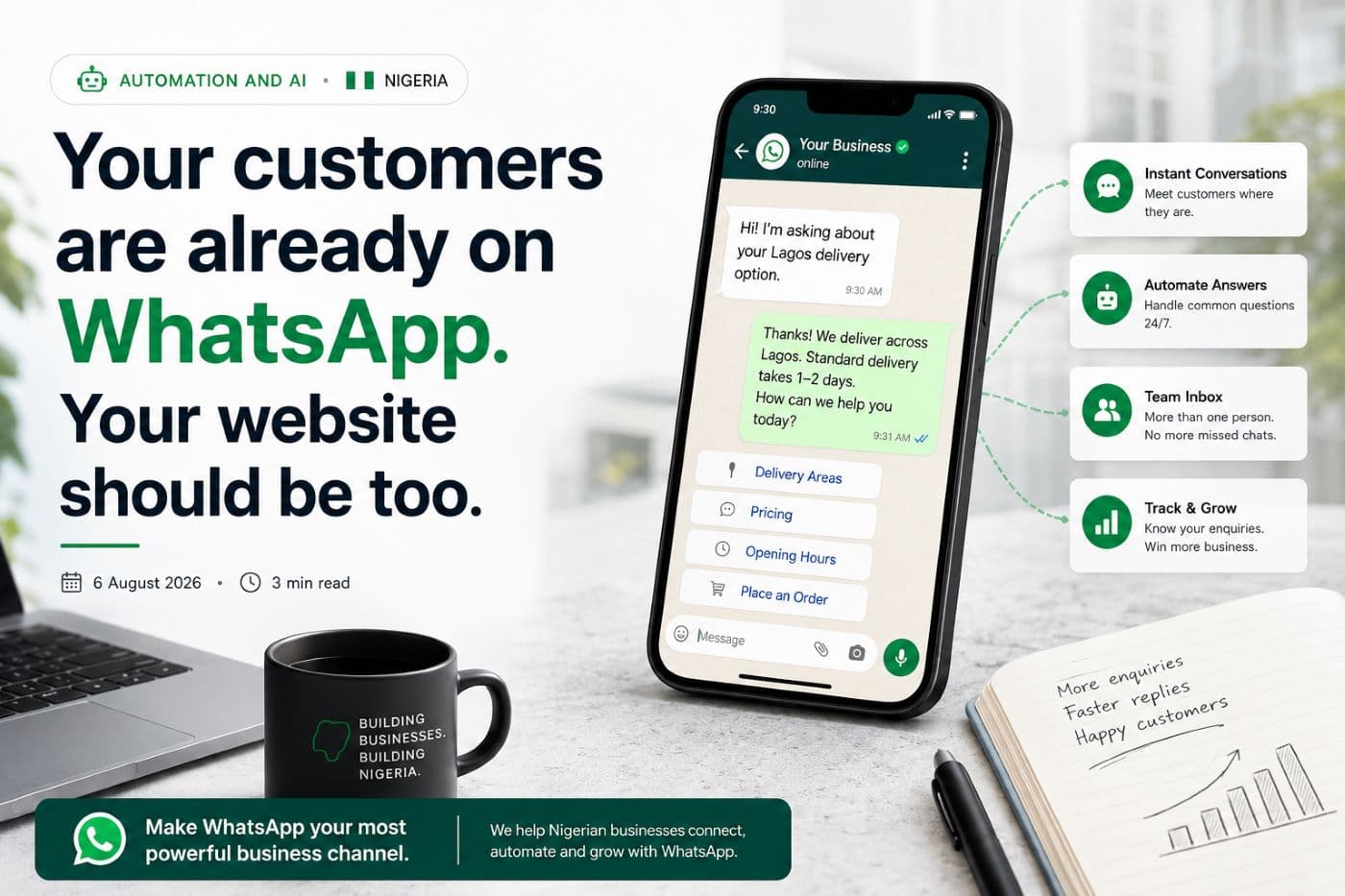
WhatsApp is a trust signal, not just a channel
Offering WhatsApp says something beyond convenience. It says a person is available and willing to be asked questions before money changes hands.
A visible WhatsApp button, answered quickly, does more for conversion than almost anything else you can add. Use a business number that more than one person can reach rather than a personal phone, and make sure the response actually happens, because a WhatsApp button nobody answers is worse than none at all.
The practical setup is covered in WhatsApp automation.
Show the work, specifically
Generic testimonials attributed to initials are read as invented, because most of them are. What works is specific.
Name the client where you can. Show the actual work, photographed rather than mocked up. Say what the job involved and roughly what it cost or how long it took. A short case study with a real name and a real photograph outperforms a page of five star quotes from "A.O., Lagos".
If you cannot name clients, show the work anyway and describe the situation honestly. Detail is what reads as true.
Be clear about money before anyone asks
Vagueness about price is read as a warning sign here more than in most markets. A visitor who cannot get any sense of cost frequently assumes they are being set up for a number that depends on how wealthy they look.
You do not have to publish a full price list. A range, a starting point, or an explanation of what drives the cost removes the suspicion and keeps people on the page. Silence does not create intrigue, it creates doubt.
The same applies to delivery, payment terms and what happens if something goes wrong. Say it plainly and you have already outperformed most of your competition.
The site itself is evidence
Fair or not, people judge whether a business is serious by whether its website works. A site that loads slowly, has broken images, mixes three fonts and shows a contact form that errors is read as a business that either cannot afford to do it properly or does not care.
The specific things people notice: does it load quickly on mobile data, does the phone number work when tapped, are there spelling mistakes, is there a padlock in the address bar, does the contact form actually send. That last one is worth testing monthly, because forms fail silently and you would never know.
What to fix first
- Put your address, phone number and RC number where they can be seen without scrolling.
- Add photographs of your premises and your team.
- Replace generic testimonials with two or three specific pieces of real work.
- Add a WhatsApp route and make sure it is answered.
- Test your contact form, today, and again next month.
None of this is expensive. All of it is the difference between a visitor who wonders whether you are real and one who picks up the phone.
See how we work with Nigerian businesses, or send us your site for an honest read.
Building something in Nigeria?
Nigeria — We design and build fast, lightweight websites and AI customer experiences for ambitious Nigerian businesses — WhatsApp-native, quick even on mobile data, and built to convert. Fixed quote, senior people on every project.
What we do in Nigeria